
Jane Mose
Author, speaker, teacher, and mom dedicated to showing Christian love to children with extraordinary challenges and their families
Jane Mose
Author, speaker, teacher, and mom dedicated to showing Christian love to children with extraordinary challenges and their families
In my last post, I explained why the traditional “key words” method of teaching students to solve math word problems doesn’t work well, especially for students with a learning disability in the area of math, such as dyscalculia. But there is an approach that works well: schema-based instruction.
Schema-based instruction is a problem-solving strategy in which students identify the underlying structure (schema) to which each word problem belongs, translate the problem’s information to a diagram, and then solve the problem. It has been shown by numerous research studies to be more effective in helping students with learning disabilities solve word problems than the traditional “key words” approach. 1 Let’s take a closer look at how schema-based instruction works in solving math word problems.
Attack Strategies
Before asking math students to use schemas to solve word problems, most teachers using this approach start by teaching their students an attack strategy for word problems. Using attack strategies is also shown by research to be effective for students with learning disabilities.1
Numerous attack strategies exist. Some have acronyms to help students remember the steps, such as DOTS:
Others don’t have acronyms, yet are still helpful attack strategies. Whichever attack strategy the teacher—or even the entire school—selects, it is crucial that it is used consistently and that the teacher explicitly models how to use the attack strategy. The teacher also needs to scaffold student learning of the strategy, decreasing the amount of support given to students and providing many opportunities for practice until the attack strategy becomes a natural part of the student’s word-problem reasoning.
Additive Schemas
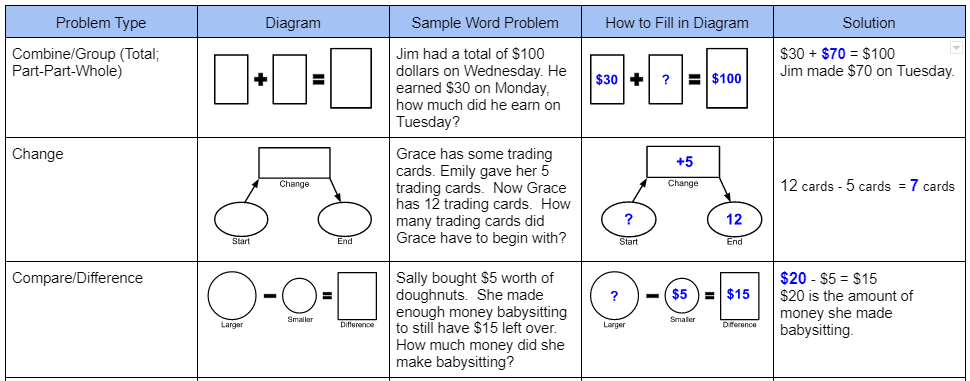
The schemas for solving word problems fall into two categories: additive schemas and multiplicative schemas. Additive schemas are used for problems that can be solved through addition and/or subtraction. The names for the schemas can vary, but three basic schemas can be used to solve all addition and subtraction problems. These three schemas are shown in this chart:
Multiplicative Schemas
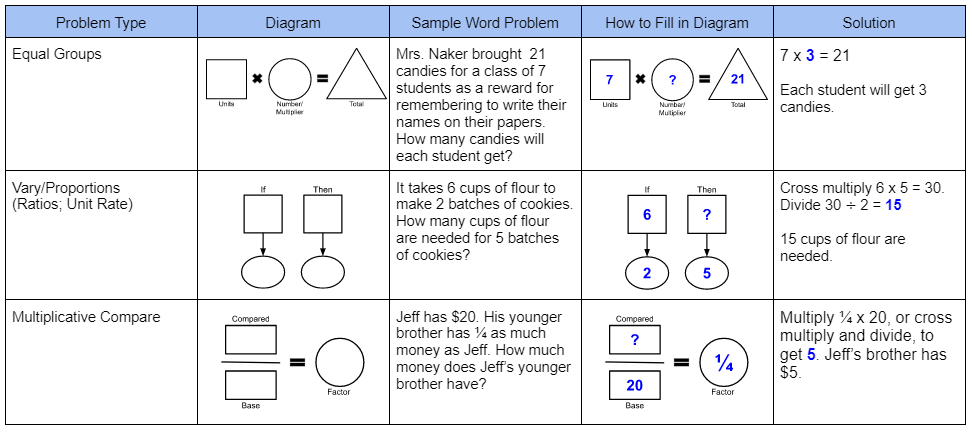
Multiplicative schemas are used for problems that can be solved through multiplication and/or addition. Again, the names for the schemas can vary, but three basic schemas can be used to solve all multiplication and division problems. Those three schemas are shown in this chart:
Teaching the Schemas
Schema-based instruction for math word problems is generally used in kindergarten through eighth grade, although usually schema-based instruction begins in the first grade. It can be used at the high school level as well, particularly to help students who continue to struggle with solving word problems in high school.
Additive schemas are taught first, usually in this order: combine, then compare, then change. An attack strategy should be taught and used alongside the schemas as the students practice solving word problems. Cumulative review is also important, mixing the types of problems so that students learn to select the correct schema for each problem.
Especially with younger children, it is helpful to teach hand gestures that represent each schema. The gestures add a visual component to help students better understand what the schemas mean.
For the multiplicative schemas, the equal groups schema is taught first, usually by the third grade. The multiplicative compare schema comes later, and finally, in middle school, the vary/proportions schema is taught. Regular, cumulative review, mixing problems with all the schemas learned at any given point, continues to be important. Also, once the students have mastered several schemas, multi-step word problems using those schemas can also be taught.
Detailed explanations on how to teach schema-based math word problem lessons are beyond the scope of this article. However, a Google search for scholarly articles on carrying out schema-based instruction can be very helpful, as are online videos showing the gestures recommended for each schema. I have also found one helpful book on teaching word problem solving through schema-based instruction: Solving Math Word Problems: Teaching Students with Learning Disabilities Using Schema-Based Instruction by Asha K. Jitendra. Step-by-step lessons with guided practice, worksheets, and visual aids using additive schemas, plus multiplicative schemas worksheets (more multiplicative resources coming soon) can also be found in my TPT store: Exceptional Ideas - Jane Mose Teaching Resources | Teachers Pay Teachers
I have successfully used schema-based instruction to help numerous students with learning disabilities solve word problems. The smiles on their faces as they enthusiastically said, “I get this!” convinced me that schema-based instruction is the way to go. I hope you will find it helpful as well!
1 https://doi.org/10.1177/0040059918777250
2 https://doi.org/10.3200/JOER.102.6.427-442
We need your consent to load the translations
We use a third-party service to translate the website content that may collect data about your activity. Please review the details in the privacy policy and accept the service to view the translations.